The 7 rules of firearms safety apply no matter the location. You must know and understand and apply the 7 rules of firearms safety if you handle firearms.
Safety on rural lifestyle properties
If you have a lifestyle block or small land holding, have shooting activities (e.g. animal and biosecurity control) happening or you are using private land for shooting activities, there are considerations you need to take.
On this page
Firearms safety
Landowners
Many landowners utilise recreational hunters to help with animal and biosecurity control on their properties.
If you are a landowner or manager, make sure you discuss their plans with any hunters prior to shooting occurring, and consider their experience and what firearms and hunting approach they plan to take.
Landowners should clearly explain land boundaries to avoid potential conflicts with neighbouring properties.
If you are looking for hunters to assist with animal and biosecurity control, your local hunting club, branch of the NZ Deerstalkers Association or Fish & Game office may be able to assist.
Unlawful hunters
It is important you notify Police of any unlawful hunting or suspicious activity. If Police don’t know, they cannot action it.
When to notify Police
If there are trespassers on property with firearms, call Police on 111.
If you are reporting a past event, including evidence of illegal hunting, call Police on 105.
Remember to provide as many details as possible, such as a description of the offender, vehicle details and licence plate numbers.
How to reduce the risk of illegal hunting on your private property
- If you see trespassers on your property with firearms, call Police on 111. If you find evidence that illegal hunting has occurred, contact police on 105.
- Make it difficult for trespassers to access the property. Lock gates or block vehicle access points to ‘at risk’ areas on your property.
- Install surveillance cameras/signs warning of surveillance cameras on road frontage.
- Investigate any unknown vehicles or suspicious activities – record details (e.g. vehicle licence plates) and report suspicious activities to the Police. Remember to act cautiously when approaching people or vehicles, particularly when alone.
- Illegal hunting activity often takes place at night. Leave lights on in buildings and be active at different times of the day.
- Take caution when working at night in known spotlighting or thermal hunting areas. Wear reflective high visibility clothing and make yourself visible with lights and noise.
- Form a neighbourhood support group to share information. Let neighbours know when you have hunters on your property and insist that boundaries are always respected.
- If you are neighboured by DoC or LINZ land clearly mark your boundary at obvious access points, such as creeks and ridges, if possible.
- Give access to trustworthy recreational hunters if appropriate. Their regular presence will deter others and they will act as another set of eyes on the property.
- Insist that any employees, recreational hunters, contractors and others who access your property are discrete about who they tell about the number and location of game animals present.
Recreational hunters
Land access
Hunters must always have permission to hunt, regardless of who owns or manages the land; whether it is conservation estate, other public lands, farmland or forestry – no permission, no access. If you are unsure who to ask for permission to access public lands, contact the Department of Conservation or relevant local authority.
When hunting with permission on private land or public land, ensure you are familiar with the boundaries and rules of the area you are hunting in. Many areas of public land don’t allow hunting or have restrictions on access to ensure the safety of all users.
If you’re using firearms on private land, it is important for you to remember that it is a privilege, and to always clarify the conditions of access with the landowner. It is important to know exactly where you can go on the property, what activities you can undertake and who is authorised to enter the property. On public land, always read and understand the conditions of your hunting permit.
Landowners have reasons for restricting access. They may have existing hunters, other incompatible land use activities or restrict access at key times of the year like lambing or calving. Permission must always be sought prior to gaining access.
Whatever the agreement with the landowner, remember you are ultimately responsible for your actions with a firearm and every time that you discharge it the responsibility to be safe and lawful sits with you.
Shooting a firearm on a lifestyle property
If you are using a firearm on a lifestyle block or a small holding, you must be aware and considerate of other people in the area where firearms are being used. If you intend to undertake shooting on a property which is close to a dwelling, buildings or other high use area, you should let the neighbours know.
Get to know the shooting area
It’s also good practice to walk the ground you intend shooting on before you undertake shooting activities to check for any unknown hazards e.g., walking tracks, fishing access, livestock, buildings, waterpipes or other infrastructure.
Check your firing zone
Before you shoot you must check your firing zone (Rule 5). Be aware of the area between you and your target, and the area beyond the target. Remember projectiles can travel very long distances. If you cannot ensure your firing zone is safe, do not fire.
It is important to remember not to discharge firearms where you could endanger or frighten people.
Shooting in low light
Shooting in low light is common for animal and biosecurity control in New Zealand as many target animals are more active during the hours of darkness. Tools to assist with low-light shooting include spotlights and night vision devices, such as image intensifiers and thermal imagers.
While these tools are helpful to the hunter, the use of them carries potential risks which you must be fully aware of. It is recommended you seek expert advice and guidance on the correct use of these items.
Refer to Section 7 of the Firearms Safety Code for more information about safe firearms practice when shooting in low light.
Sighting in
If you are using firearms to shoot targets, you must select a safe location with a suitable backdrop for the range and power of the firearm used.
For further information on informal target shooting on private property see the Section 7 in the Shooting Range Manual Zeroing (Sighting-in/Sight adjustment) conducted on private/ public land.
Consider what type of firearm and ammunition you are using
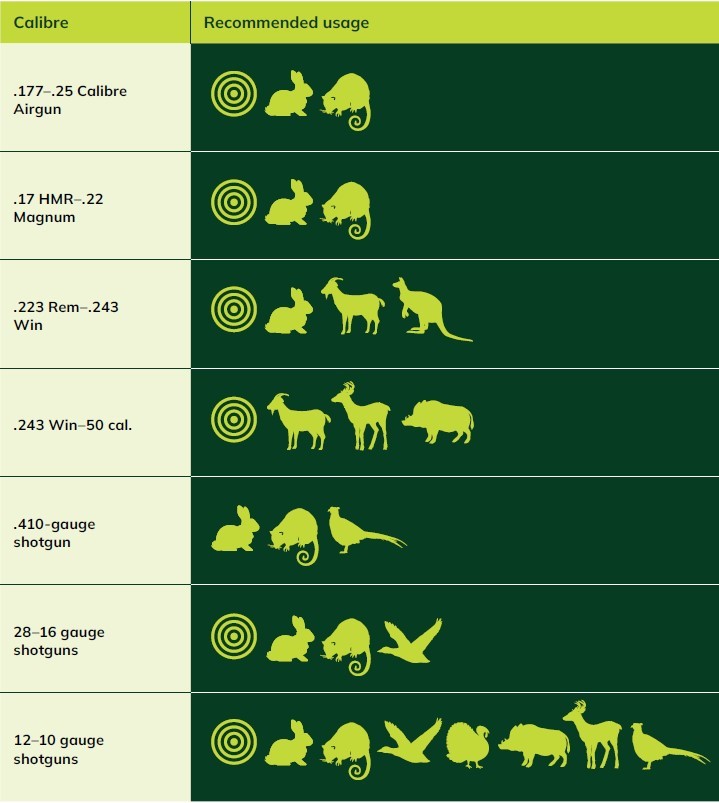
It is important you consider what type of firearm you are using, depending on the terrain and the type of shooting you wish to undertake.
For example, a suppressed .22 rimfire rifle is quiet to use but the bullet can travel a long way and will ricochet off hard surfaces easily. A shotgun is much louder to fire, but the smaller projectiles generally travel a much shorter distance and present a lesser risk of ricochet. High powered air rifles can be used for controlling small game such as rabbits and possums at short distances but are less effective than a rimfire rifle or shotgun.
Knowing the maximum projectile range of your firearm is critical to being a safe and responsible shooter.
The maximum projectile range is the absolute distance (without consideration of accuracy) that your firearm’s projectile can travel when fired at the barrel’s optimum angle of elevation. You can refer to Section 4 of the Firearms Safety Code for more information about the range and impact potential of your firearm and ammunition.
A projectile from a stray shot or ricochet can travel a long way outside of your intended firing zone and property boundaries before it returns to earth, potentially causing injury or damage to people, animals or property. Knowledge of maximum projectile range can help a shooter assess whether it is safe to fire.
If you are unsure which calibre or ammunition type is best suited to the type of shooting you wish to undertake, consult a relevant club/organisation or experienced shooter, or ask a firearms retailer or gunsmith for recommendations.
Seek advice from experienced and knowledgeable hunters on ethical and humane practices when hunting or undertaking animal and biosecurity control.
Notifications
Neighbours
Where possible, notify neighbours that you plan to undertake shooting activity. In semi-rural areas, or lifestyle blocks, you may encounter people who are unfamiliar with firearms use. Hearing shooting activity being undertaken may frighten them or disturb animals. Neighbours may want to shift livestock or keep domestic pets indoors when shooting activities are happening.
Notifying your neighbours prior to the use of firearms may alleviate concerns and help to prevent unnecessary concern and Police call outs.
When to notify Police
If significant shooting activity is being undertaken (e.g., animal and biosecurity control), you may want to notify the Police (dial 105) and leave them with your contact details. They will ask the location of the property, who is undertaking shooting activity and their contact number, the firearms being used, the animals being targeted and the times between which the shooting is likely to occur.
| Need help? | |
 | Phone 0800 844 431 (04 499 2870) 8.30am to 5pm, Monday to Friday |